
CARMEL VALLEY MANOR / MID-VALLEY, Monterey County — October 30, 2026. Before Carmel Valley Manor became a senior-living community beside Carmel Valley Road, the land was known as Hollow Hills Farm. The Manor’s published institutional timeline traces the site from a former agricultural property selected in 1959 to a retirement community that opened in 1963, established its first elected Residents’ Council in 1964 and later contributed nearly three acres for a Mid-Valley fire station in 1975. Those milestones help explain why the names Hollow Hills and Carmel Valley Manor appear in local stories about the area’s land use and public facilities.
This is an account of community history, based primarily on the operator’s dated institutional records, not an announcement of a new parcel donation, construction contract or public hearing in 2026. Where the historical source is the Manor’s own recollection, the account is attributed to the organization and should not be mistaken for an independently reviewed property-deed or fire-station-title search.
1950–1960: a church proposal became a land purchase
According to Carmel Valley Manor’s official history, Northern California Congregational churches petitioned their denomination in 1950 to give more attention to the needs of older people. A board searching for a property visited Hollow Hills Farm in 1959, attracted by the agricultural landscape, its trees and buildings. The institution says the land purchase was finalized in 1960.
The farm name survived in the Hollow Hills Chapel, which the institution says was named in honor of the property’s former identity. For a community built on a landscape of older ranches and farm holdings, that continuity provides a link between its present residential campus and the Mid-Valley area’s rural past.
The original adobe and the first plans
The operator’s history states that Dr. and Mrs. Pratt moved into the property’s original adobe cottage, identified as the Guest House, in 1960 and lived there for three years. The sponsoring board authorized creation of the nonprofit Northern California Congregational Retirement Homes, Inc., the body organized to develop and administer a home for older residents.
The nonprofit board chose the San Francisco architectural firm Skidmore, Owings & Merrill for the initial plans. The Manor says the designs were publicly discussed and that the Monterey Peninsula Herald reported on them ahead of Planning Commission consideration. The reference to an architect is a statement about historic design; it does not assert that every subsequent campus building was designed by the same firm.
1962–1964: building opens and residents gain a council
The institution dates the beginning of construction to 1962 and its opening to 1963. By the next year, it reports that Dr. Pratt proposed a resident representative body and appointed a four-member nominating committee. Nine nominees were selected, and residents elected the first Residents’ Council in 1964.
That early council forms a significant part of the property’s local identity: an organized community of older residents was participating in its own institutional life within the first year after opening. It is not evidence that the Residents’ Council controls county roads, land-use permits or the public budget; the council’s role concerns the residential community and its internal affairs.
1975: land for Mid-Valley fire protection
One especially local entry in the timeline concerns 1975. Carmel Valley Manor states that its board donated nearly three acres of land to Monterey County, property acquired in connection with Hillcrest House, for the purpose of building a fire station to support Mid-Valley fire protection.
The history does not identify a current fire-station assessor’s parcel number, give the date an individual structure opened, or establish the present ownership of every nearby parcel. Those details would require county recorded deeds, fire district archives and subsequent land transactions. The point supported by the Manor’s own account is that the nonprofit describes a historical land contribution for a public-safety use, not a 2026 donation or a newly funded station.
How the campus continued changing
The institution lists the 1995 groundbreaking for a health-center project, a 2001 fitness-center opening, a 2011 dining-room extension and its 50th anniversary in 2013. It also commemorated its 60th anniversary in 2023. These improvements span decades and should not be confused with the planning approval granted in May 2026 for the separately proposed residential and memory-care expansion.
California58 already reports on that current county permit and on the separate sewer-infrastructure project. The present article focuses exclusively on the institution’s origins and earlier relationship with the surrounding community. A historical timeline can help readers follow change without mistaking an older site improvement for a new construction completion.
Where local historians can check further
For original property details, the logical next records are Monterey County Recorder deeds, historical parcel maps, local fire-service archives, newspaper microfilms and the institution’s historic board minutes. The Manor’s timeline is a useful starting point but is a corporate history, not a substitute for those independent archives. Readers with photographs, dated maps or other documentation of Hollow Hills Farm, the chapel or the former fire-station property are invited to submit them with information about provenance and permission to reproduce.
Primary institutional history: Carmel Valley Manor — About Us, timeline from 1950 to 2023, including the 1959–60 Hollow Hills Farm purchase, 1963 opening, 1964 Residents’ Council and 1975 fire-station land entry. The Manor’s public address is 8545 Carmel Valley Road, Carmel, CA 93923. Historical feature published October 30, 2026. Specific title deeds and fire-station parcel boundaries have not been independently authenticated.
Historical corrections and documents: California58 Newsroom.
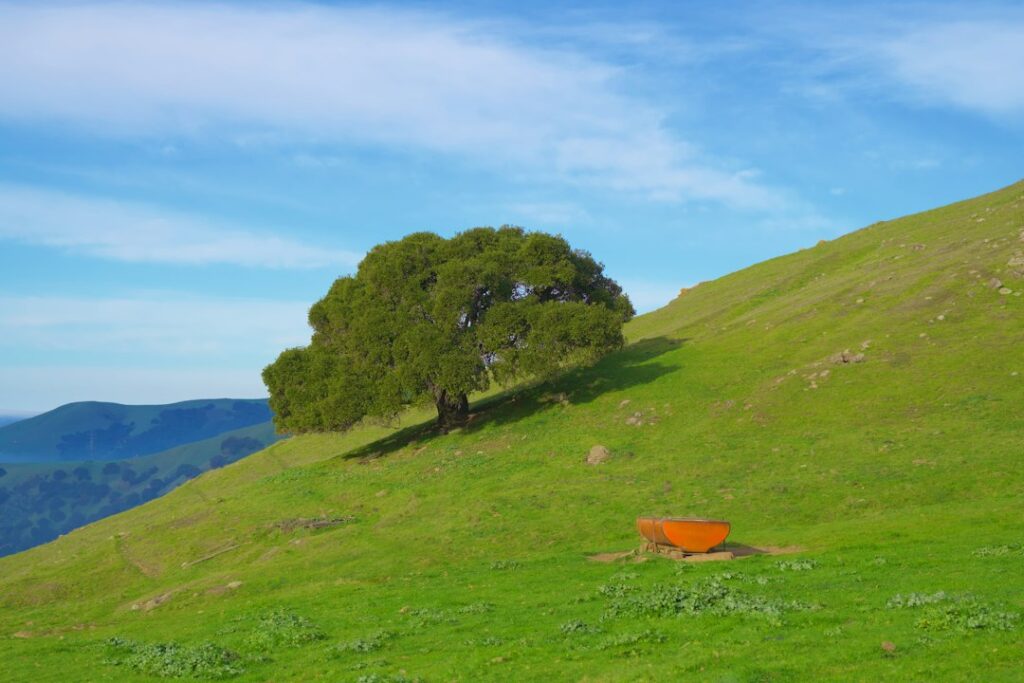
Featured photo: illustrative oak and grassland by Spencer DeMera / Unsplash. It does not depict Hollow Hills Farm, its historic adobe, the Carmel Valley Manor campus, or the 1975 fire-station land donation.
Support Carmel Valley Manor News
Choose how to support Carmel Valley Manor News:
Credit / Debit Card via StripeChoose your contribution amount on the secure California58 Stripe checkout. One-time support for independent local journalism.
Continue with PayPal Continue with ZelleZelle payments go to Vitaly Ataev Troshin. Please verify the recipient in your bank before sending. Availability depends on your bank.
Optional reader support. When possible, add “Carmel Valley Manor News” to the payment note. Contributions are not advertised as tax-deductible. Support does not influence editorial decisions.More from Carmel Valley Manor News
- Carmel Valley Manor’s $8 Million Sewer Project: 2023 Roadwork Schedule Still Lacks a Final Paving Date →
- Carmel Valley Manor Has 36 State-Licensed Skilled-Nursing Beds; Proposed Memory-Care Wing Is Separate →
- Carmel Valley Manor Bookmobile Stop Continues on Wednesdays: County Lists 1–2 p.m. Service →
- Carmel Valley Manor Expansion Approved May 13: 19 Residences, 12 Memory-Care Beds and 61 Oaks in Permit →
COMMUNITY
Comments
Join the California58 conversation. You must be signed in to comment.
Create a free California58 account or sign in with an available social provider.